

Make: TAYLOR
Model: TXH350L
Year: 2016


Make: Manitou
Model: 48" Forks
Year: 2012

Make: JLG
Model: Truss Jib 12'
Year: 2011

Make: Capacity
Model: TJ5000 DOT
Year: 2010

Make: JLG
Model: 450AJ
Year: 2016

Make: FrostFighter
Model: IDF350
Year: 2015
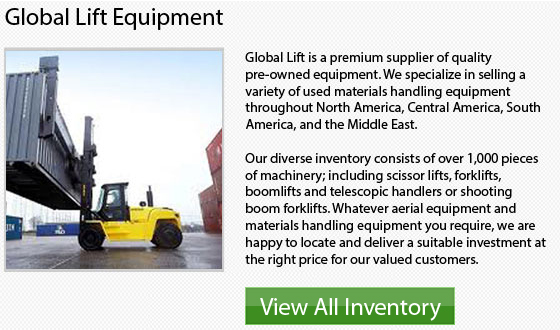
Mitsubishi LP Forklifts Arlington
Since its introduction during the early 1920s, the lift truck has become an invaluable piece of equipment found in numerous industrial operations and warehousing. Clark, one of the pioneers of the very first lift truck, has grown to become a leader within the material handling business and still remains a top supplier. Other popular names in the making of these machines consist of: Nissan, Yale, Hyster Cat, Toyota and Mitsubishi.
Hyster has grown to become one of the most popular models of lift trucks in the industry. In fact, in several regions, the word "Hyster" is synonymous with forklift. Other common names for this industrial lifting machinery include: high/low, lift truck, jitney, fork truck and stacker truck.
The ancestor of today's machinery was first made during the early part of the 19th century. At this time, battery-powered, small units were made for the purpose of moving traveler's baggage in Pennsylvania at the Altoona train station. During the First World War, some different versions were made in England specially to be utilized in the material handling industry. These machines evolved as a solution to the lack of manpower at that time.
The modern equivalents come in a variety of sizes and configurations. There are the large truck-mounted forklift units which are also referred to as sod loaders and then the opposite end of the spectrum has small hand truck models. There are also a line of automated versions known as forklift automated guided vehicles that are basically robotic in nature. These units were developed to improve production and as a means of lowering operational costs.
Attachments have been made to fit onto lots of regular lift trucks, giving them the capability of performing a wider selection of jobs. The motors could be IC or internal combustion units, running on propane, diesel or gasoline, or there are battery operated options which require regular charging. Standard warehouse units would usually be rated to raise between about 1 and 5 tons.
The forklift has become a priceless part in the material handling business. Thousands of these models are used each day throughout the globe to complete jobs that used to require much more man-power. Operators need to take stringent training programs in order to operate these heavy equipment safely and legally. Many workers have better health overall and longer careers now due to their not having to raise objects manually anymore as the forklifts can handle those situations now instead.
- MEC Scissor Lifts Arlington
Safety Requirements for Scissor Lifts Scissor lift machinery are known as "moveable scaffolds," according to the OSHA. These industrial machines are capable of lifting heavy and large loads that are balanced well. They are responsible... More - Doosan Dual Fuel Forklifts Arlington
Basic Training Information for LPG Liquid petroleum gas or LPG is a odorless and colorless fuel derived from natural gas. LPG consists of 90% propane. It is extracted in a process referred to as distilling.... More - Mitsubishi Counterbalance Forklifts Arlington
Unfortunately, industrial accidents and injuries at construction sites are extremely common and occur more often than anybody would prefer. According to statistics, a huge majority of these mishaps occur because of inadequate or wholly absent... More - Terex Reach Stackers Arlington
The Reach Stackers made by Terex are economical in operation. These units have been meticulously designed and engineered to suit the needs of a diverse customer base. The Reach Stacker range is more flexible than... More - Wolff Tower Cranes Arlington
During 1861, the company Harland and Wolff was formed. Mr. Gustav Wilhelm Wolff, born in Hamburg in 1834, along with Mr. Edward James Harland born during 1831, formed the business. In 1858 Harland, who was... More