

Make: TAYLOR
Model: TXH350L
Year: 2016


Make: Manitou
Model: 48" Forks
Year: 2012

Make: JLG
Model: Truss Jib 12'
Year: 2011

Make: Capacity
Model: TJ5000 DOT
Year: 2010

Make: JLG
Model: 450AJ
Year: 2016

Make: FrostFighter
Model: IDF350
Year: 2015
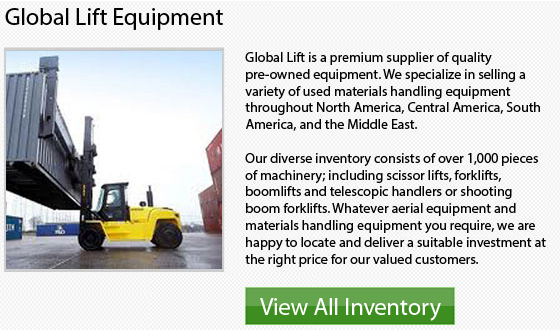
Caterpillar Propane Forklifts Arlington
There are disadvantages and advantages to both electric and internal combustion (IC) trucks.
Electric engines cost less to maintain during their life span since they need less maintenance. The battery should last five years minimum if the manufacturer's maintenance and charging guidelines are followed. Overnight charging expenses are normally low. Electric trucks tend to be very maneuverable and compact units, specially the models with three wheels. Drive, lift, tilt, auxiliary and acceleration speeds are adaptable and can be changed depending on the application and the preferences of the driver. Electric trucks are easier on the environment and are quiet.
Electric trucks are not best to use during wet conditions. Because of the need for battery recharging, they cannot be constantly used. They are not suited to rough terrain. The energy consumption is high on continuous high lifts and ramp work.
IC engine diesel/LPG has the advantage of being suitable for continuous outdoor use and uneven surfaces. With no requirement for battery charging, the forklift can be used throughout the evening and overnight. Supply and transport of fuel must be factored into costs. Initial expenses are less than for an electric truck, but long term expenses related to fuel and maintenance are higher. IC engines have larger capacities compared to electric, but less adaptability. LPG could be utilized in several indoor applications. IC Engine diesel/LPG produces more noise and higher emissions than electric. LPG has lower emissions compared to diesel.
- MEC Scissor Lifts Arlington
Safety Requirements for Scissor Lifts Scissor lift machinery are known as "moveable scaffolds," according to the OSHA. These industrial machines are capable of lifting heavy and large loads that are balanced well. They are responsible... More - Doosan Dual Fuel Forklifts Arlington
Basic Training Information for LPG Liquid petroleum gas or LPG is a odorless and colorless fuel derived from natural gas. LPG consists of 90% propane. It is extracted in a process referred to as distilling.... More - Mitsubishi Counterbalance Forklifts Arlington
Unfortunately, industrial accidents and injuries at construction sites are extremely common and occur more often than anybody would prefer. According to statistics, a huge majority of these mishaps occur because of inadequate or wholly absent... More - Taylor Reach Stackers Arlington
TS Series Reach Stackers Taylor has set a new standard with their newest reach stacker container handlers. Their newest TS-9972 Reach Stacker is a user friendly, really comfortable and durable machinery. The TS-9972 has all... More - Wolff Tower Cranes Arlington
During 1861, the company Harland and Wolff was formed. Mr. Gustav Wilhelm Wolff, born in Hamburg in 1834, along with Mr. Edward James Harland born during 1831, formed the business. In 1858 Harland, who was... More