

Make: TAYLOR
Model: TXH350L
Year: 2016


Make: Manitou
Model: 48" Forks
Year: 2012

Make: JLG
Model: Truss Jib 12'
Year: 2011

Make: Capacity
Model: TJ5000 DOT
Year: 2010

Make: JLG
Model: 450AJ
Year: 2016

Make: FrostFighter
Model: IDF350
Year: 2015
CAT Telescopic Forklifts Arlington
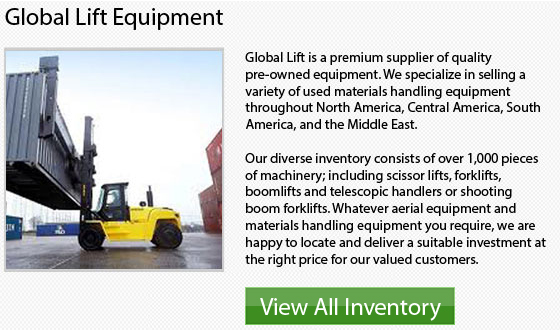
The telescopic handler or just telehandler is a heavy duty machinery which is popular within both the construction and agriculture industries. These equipment are quite similar in both appearance and function to the lift truck, except it more closely resembles a crane. The telehandler provides improved versatility of a single telescopic boom which could extend upwards and forwards from the vehicle. The operator could connect numerous attachments on the end of the boom. Some of the most popular attachments include: a bucket, a muck grab, pallet forks or a lift table.
A telehandler usually utilizes pallet forks as their most popular attachment to be able to move loads through locations that are usually unreachable for a standard forklift. Like for instance, telehandlers could move cargo to and from locations that are not typically reachable by conventional forklift units. These devices also have the ability to remove palletized cargo from in a trailer and position these loads in high locations, like on rooftops for instance. Before, this abovementioned situation will need a crane. Cranes can be really expensive to use and not always a time-efficient or practical alternative.
Telehandler's are unique in that their advantage is also their biggest limitation: as the boom extends or raises when the equipment is bearing a load, it also acts as a lever and causes the vehicle to become quite unbalanced, even with the rear counterweights. This translates to the lifting capacity decreasing quickly as the working radius increases. The working radius is the distance between the front of the wheels and the center of the load.
For example, a vehicle that has a 5000 pound capacity with the boom retracted might be able to safely lift only as heavy as 400 lb. when it is completely extended with a low boom angle. The same unit with a 5000 pound lift capacity which has the boom retracted might be able to easily support as much as 10,000 pounds with the boom raised up to 70.
England originally pioneered the telehandler within Horley, Surrey. The Matbro Company developed these equipment from their articulated cross country forestry forklifts. Initially, they had a centrally mounted boom design on the front section. This positioned the cab of the driver on the back portion of the machine, like in the Teleram 40 unit. The rigid chassis design with the cab situated on the side and a rear mounted boom has ever since become more popular.
- MEC Scissor Lifts Arlington
Safety Requirements for Scissor Lifts Scissor lift machinery are known as "moveable scaffolds," according to the OSHA. These industrial machines are capable of lifting heavy and large loads that are balanced well. They are responsible... More - Doosan Dual Fuel Forklifts Arlington
Basic Training Information for LPG Liquid petroleum gas or LPG is a odorless and colorless fuel derived from natural gas. LPG consists of 90% propane. It is extracted in a process referred to as distilling.... More - Nissan Counterbalance Forklifts Arlington
Counterbalance lift trucks are essentially forklifts that are designed with counterweight at the back of the machine. The counterweight works to balance the weight which the tines are carrying at the front of the cargo.... More - Taylor Reach Stackers Arlington
TS Series Reach Stackers Taylor has set a new standard with their newest reach stacker container handlers. Their newest TS-9972 Reach Stacker is a user friendly, really comfortable and durable machinery. The TS-9972 has all... More - Komatsu Warehouse Forklifts Arlington
Warehouse Forklift Maintenance Having a proper maintenance program for forklifts would help to increase the lifespan of the equipment and is also a critical factor to the safe use of the equipment. Completing regular forklift... More